
On October 21, 2025, OpenAI unveiled ChatGPT Atlas, an AI-powered web browser designed to integrate ChatGPT directly into the browsing experience. This launch marks a significant move by OpenAI to expand its footprint beyond chat applications and into the core of internet browsing. Initially available for macOS, with plans for expansion to Windows, iOS, and Android, Atlas offers a personalized web experience through a ChatGPT sidebar. This feature allows users to interact with content on webpages by summarizing, comparing, analyzing, and even rewriting text.
Impact on Alphabet’s Stock Price
The introduction of Atlas had immediate market repercussions. Alphabet Inc., Google's parent company, saw its shares drop approximately 4.8% following the announcement, with market capitalization declining by over $150 billion in a single session—highlighting investor concerns about potential disruption to Google's search and browser dominance.

What Makes ChatGPT Atlas Different?
ChatGPT Atlas is not just another browser with a chat function added on—it places ChatGPT at the center of the experience. Sam Altman, OpenAI’s CEO, described Atlas as a "rare once a decade opportunity to rethink what a browser can be," positioning the chat interface as the modern analog for interacting with the web and replacing the traditional URL bar and search box. He emphasized that the browser is where "a ton of work and sort of life happens," and integrating ChatGPT as a core tool allows users to chat with pages, find information, and leverage Agent mode to perform tasks.
Ben, OpenAI’s Engineering Lead, stressed that Atlas was intentionally designed to avoid feeling like an old browser with a chat button bolted on. He noted that using Atlas makes him "more curious" and a "better informed person," summarizing it as a "new kind of browser for the next era of the web."
The browser’s core features are:
Deep AI Integration and Context
- Side Chat sidebar: Provides real-time interaction with webpages, such as summarizing key points or extracting critical data from a long article without leaving the page.
- Upgraded search experience: Enables conversational search with a split view, allowing users to refine search results or calculate ingredient quantities when looking up a recipe.
- Natural language navigation: Allows intuitive commands for navigation, like opening saved articles from a news website by typing the command directly.
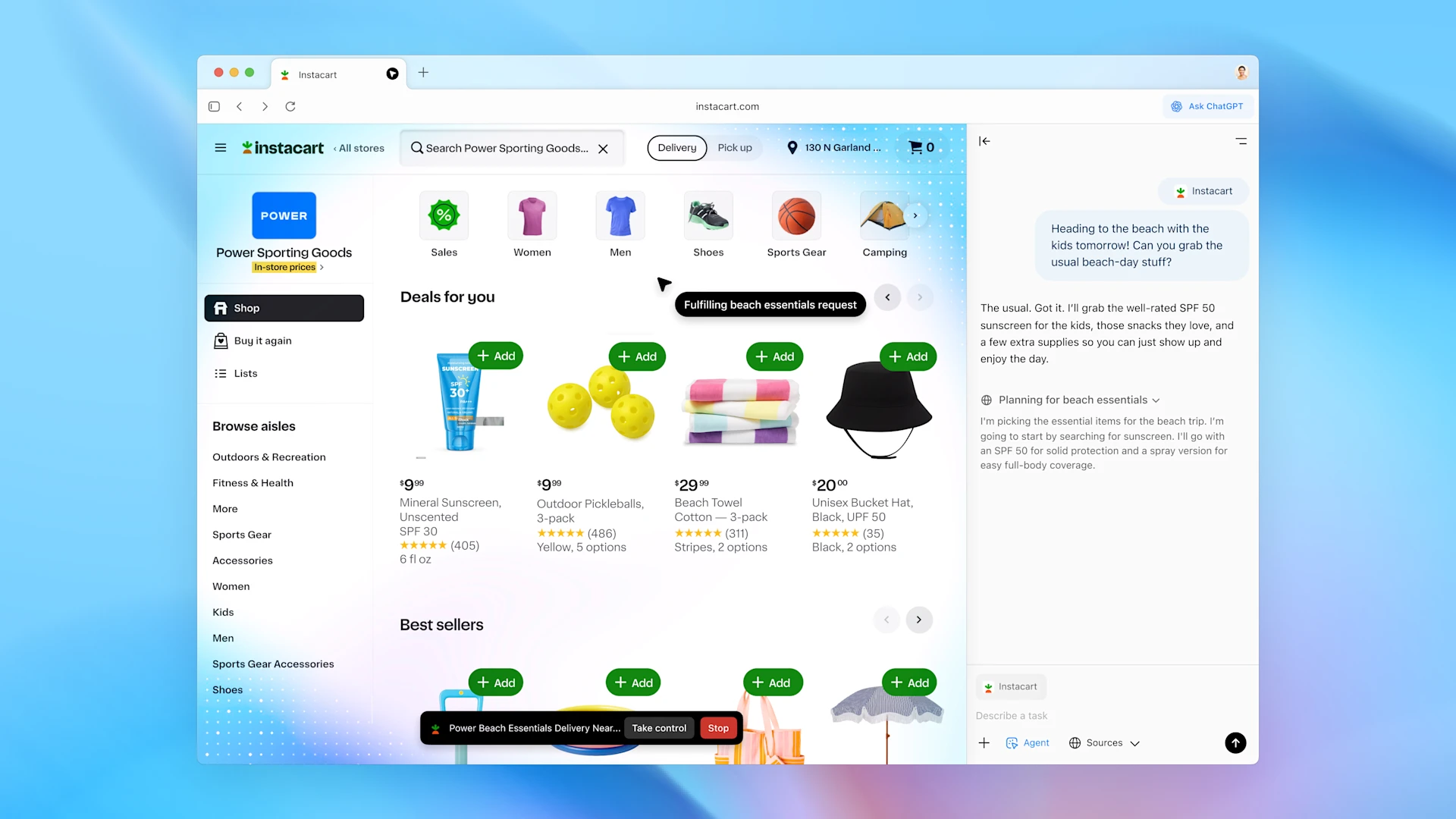
Action Capabilities (Agent Mode)
- Task automation: ChatGPT performs tasks on behalf of the user, including booking flights, scheduling meetings, or adding tasks to a project management tool.
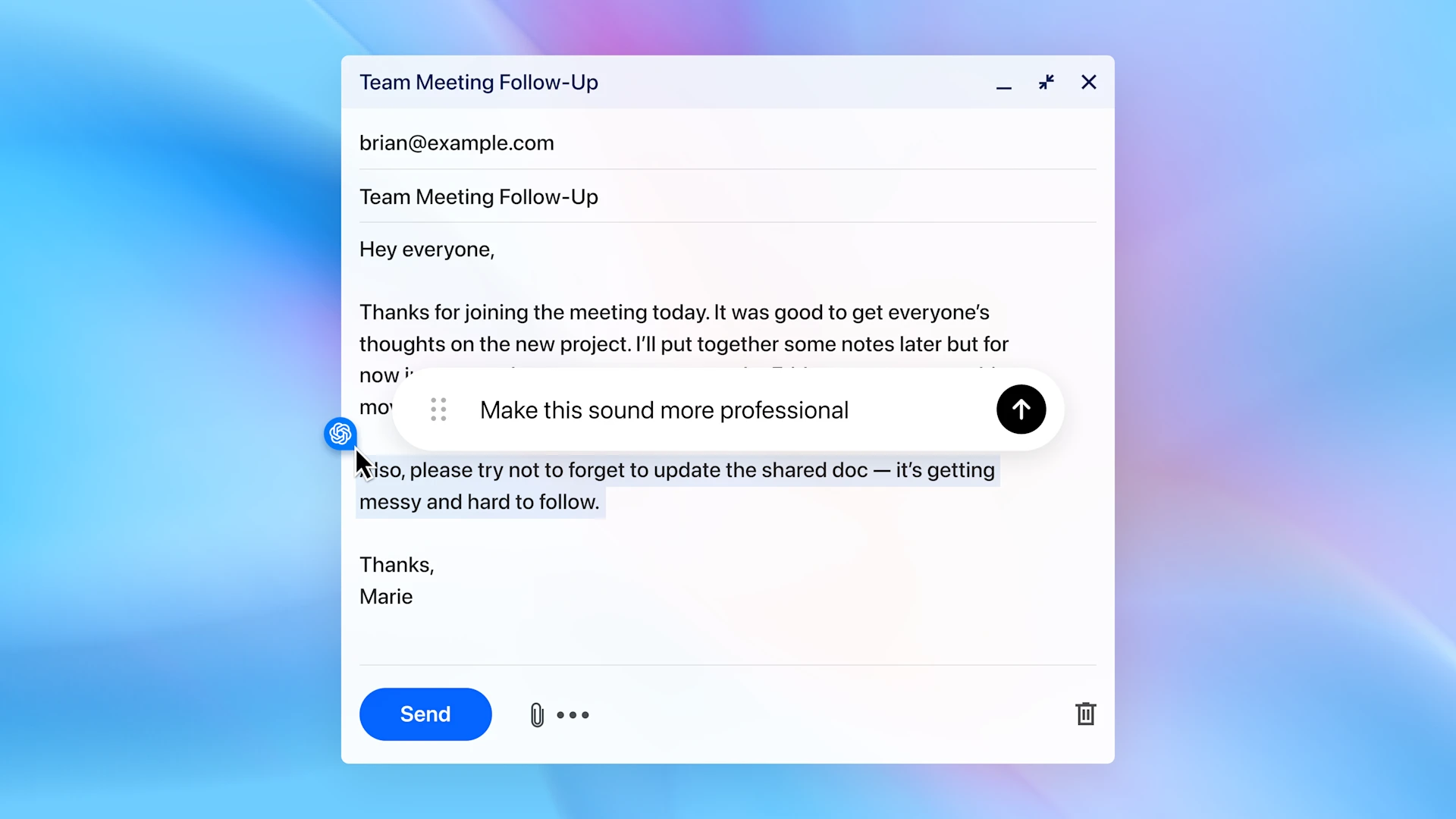
- Scoped edits: Enables in-line text adjustments, such as selecting text in an email and asking Atlas to make it more formal or simplify a paragraph.
- Background operation: Executes tasks while the user continues browsing, allowing multitasking without interruption.
Personalization and Memory
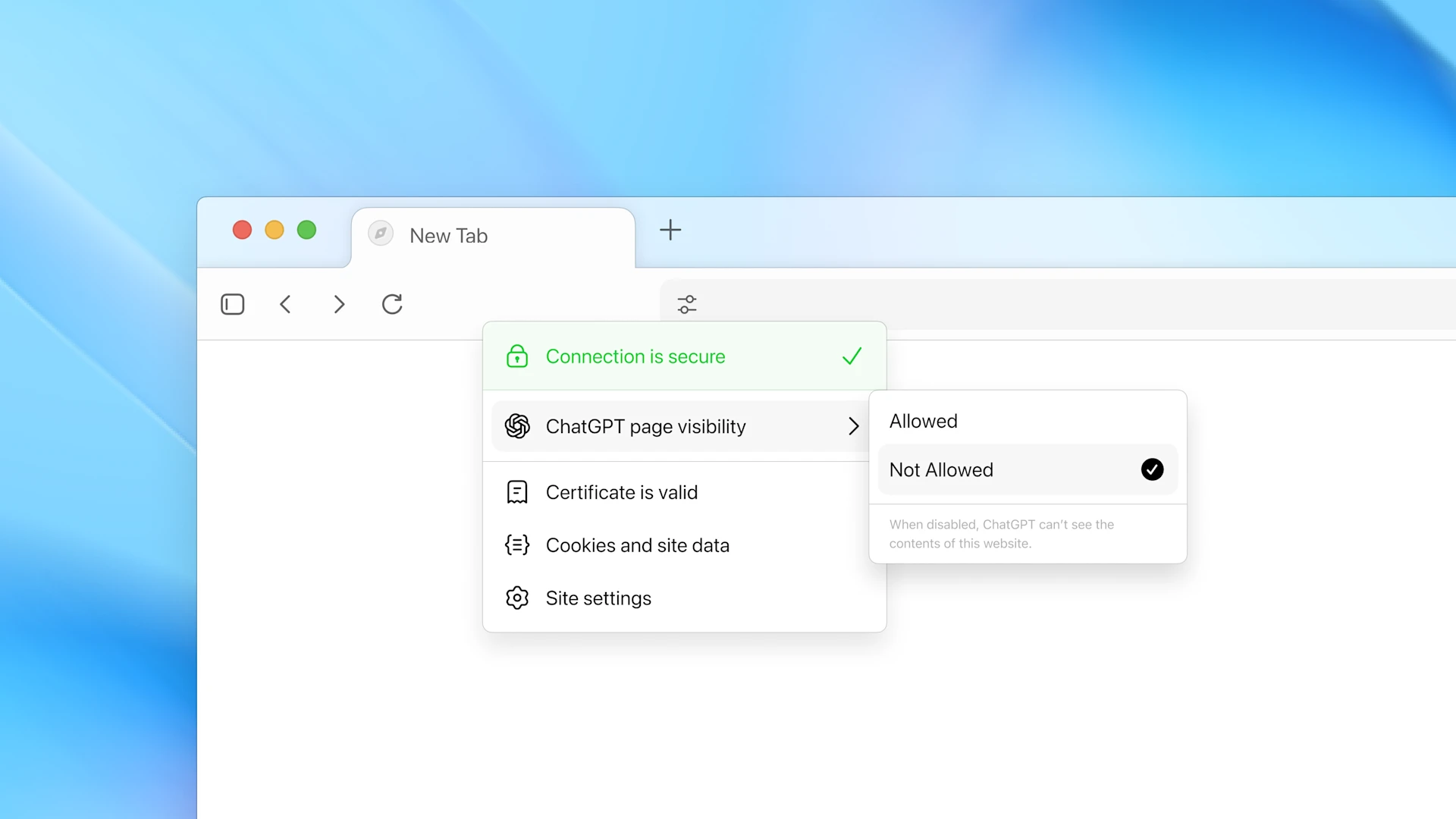
- Browser memory: Learns user behavior to offer personalized assistance over time.
- Search history in natural language: Users can quickly locate past documents, like a PDF opened last week about cloud computing.
- Home screen suggestions: Provides recommendations for news, tasks, or delegated actions based on recent activity.
ChatGPT Atlas Real-World Use Case: Automating Online Shopping
A practical demonstration of Atlas's capabilities was conducted by investigative journalist Gregory Zuckerman, who allowed Atlas to handle his Walmart shopping. Initially, Atlas encountered challenges such as language-selection pop-ups and the absence of login credentials, which hindered its ability to access personalized information. However, after providing specific prompts and logging into his account, Atlas successfully navigated Walmart's website, selected items from his purchase history, and completed the checkout process, including setting a delivery window and confirming payment. This experiment highlighted Atlas's potential to streamline online shopping tasks, though it also underscored the need for user oversight to handle dynamic website elements and ensure accurate order fulfillment.
Recent OpenAI Strategic Partnerships
OpenAI’s Atlas initiative is underpinned by major strategic partnerships and significant investments. Nvidia has committed staged investments up to $100 billion, providing the infrastructure to support Atlas and other AI initiatives, highlighting the growing interdependence between AI software developers and hardware providers. OpenAI also acquired io, an AI hardware startup founded by Jony Ive, for $6.4 billion, aiming to optimize integration between hardware and software for enhanced AI performance.
What Does OpenAI's Future Look Like Post-Atlas Launch?
OpenAI’s Atlas initiative is underpinned by major strategic partnerships and significant investments. Nvidia has committed staged investments up to $100 billion, providing the infrastructure to support Atlas and other AI initiatives, highlighting the growing interdependence between AI software developers and hardware providers. OpenAI also acquired io, an AI hardware startup founded by Jony Ive, for $6.4 billion, aiming to optimize integration between hardware and software for enhanced AI performance.
Strategic Collaborations and Infrastructure Expansion
In October 2025, OpenAI announced a strategic collaboration with Broadcom to develop 10 gigawatts of custom AI accelerators. This partnership aims to enhance OpenAI's hardware capabilities, enabling more efficient processing and deployment of AI models.
Additionally, OpenAI has secured significant investments to bolster its infrastructure. Nvidia committed up to $100 billion to support the deployment of 10 gigawatts of AI data centers, utilizing Nvidia's systems to power OpenAI's next-generation models. Similarly, AMD entered into a multi-year partnership with OpenAI, providing 6 gigawatts of AMD Instinct GPUs, with the first deployment scheduled for 2026.
Global Expansion and Strategic Partnerships
OpenAI's global footprint is expanding through strategic partnerships. In October 2025, OpenAI and Japan's Digital Agency announced a collaboration to explore the use of generative AI in enhancing public services in Japan. This initiative aims to promote international AI governance and the responsible use of AI technologies.
Furthermore, OpenAI's collaboration with South Korean tech giants Samsung and SK Hynix focuses on developing large-scale AI infrastructure. This partnership is part of OpenAI's $500 billion "Stargate" project, which includes building AI data centers and securing energy resources to support AI growth.
Financial Growth and Market Position
OpenAI's financial trajectory reflects its expanding influence in the AI sector. In August 2025, OpenAI completed a $40 billion funding round, valuing the company at $300 billion. Investors in this round included SoftBank, Thrive, T. Rowe Price, Dragoneer, Blackstone, TPG, Founders Fund, Sequoia Capital, and Andreessen Horowitz.
Despite these investments, OpenAI faces challenges. The company reported $4.3 billion in revenue in the first half of 2025 but also incurred significant expenses, including $6.7 billion in research and development costs. These expenditures underscore the financial demands of scaling AI infrastructure and developing advanced models.
What Investment Opportunities Could ChatGPT Atlas Bring?
The launch of ChatGPT Atlas opens multiple avenues for investors across different sectors of the AI and tech ecosystem.
AI Infrastructure and Cloud Computing Companies providing the computing power and cloud services required for Atlas’s AI capabilities are likely to see increased demand. Nvidia, with its AI-optimized GPUs, and Microsoft, through its Azure cloud platform, are well-positioned to benefit from the growing adoption of AI-powered browsers. Amazon Web Services (AWS) also stands to gain as businesses scale AI workloads.
Software and Enterprise Productivity Atlas introduces new possibilities in AI-driven software and productivity tools. Firms offering enterprise automation or collaboration solutions, such as Salesforce and Adobe, could integrate Atlas-like AI assistants into their platforms, creating new value propositions for corporate clients. Productivity-focused SaaS providers that enable task automation may also see higher adoption rates.
Consumer Applications and E-commerce Atlas’s practical use cases, such as automating online shopping or personal organization, highlight opportunities in consumer-facing applications. Companies like Shopify, Instacart, and Walmart could see increased engagement as AI-driven browsing encourages automated shopping or streamlined online interactions. Atlas may further accelerate demand for AI-powered personal assistants in consumer apps.
Hardware and Device Makers As Atlas leverages advanced AI features, hardware companies providing high-performance devices for AI workloads could benefit indirectly. Apple, with its macOS integration, and Intel, through high-performance CPUs, are examples of companies positioned to gain from increased adoption of AI-intensive applications.
Overall, Atlas creates a network effect that benefits firms supporting AI infrastructure, enabling tools, or offering complementary services. Investors can focus on companies positioned to scale with AI adoption while monitoring market shifts among traditional tech incumbents facing competitive pressure.
Conclusion
OpenAI's launch of ChatGPT Atlas not only challenges Google's dominance in the browser and search markets but also signals a broader shift toward more intelligent, AI-integrated browsing experiences. For investors, the move underscores both risk and opportunity: legacy players must innovate or risk losing market share, while AI infrastructure and cloud service providers could benefit significantly. The next phase of technological development appears set to reward those capable of integrating AI seamlessly into user experiences and enterprise solutions.